Sri Brahmalingeshwara Temple, Kanajar
Sri Brahmalingeshwara Temple, Kanajar
Latest
News & Events
Kanajar Utsava
21-12-2026 MondayNight : Vasthu Raksha Kalapam, Muhurthabali
22-12-2026 TuesdayMorning : Ganayaga, Dhwajarohana, Mahapooja, Navaka Pradhana.
Night : Nithyabali, Rashikai, Bhutabali
23-12-2026 WednesdayAfternoon : Mahapooja, Varasare
Night : Nithyabali, Thambila Pooja, Brahmamandalothsava, Bhutabali
24-12-2026 ThursdayAfternoon : Mahapooja, Ambodi, Ashleshabali
Night : Nithyabali, Poorvaswari, Kendaseve, Maharangapooja, Bhutabali
25-12-2026 FridayAfternoon : Mahapooja, Pallapooja, Ratharohana
Night : From 8.00 p.m. – Srimanmaharathotsava, Kere Utsava, Rathripooja, Mahabhutabali, Kavatabandhana
26-12-2026 SaturdayMorning : From 8.30 a.m. – Kavatodghatane, Dashavidhasnana, Ushakala Pooja, Devara Sandarshana, Thulabhara Seve, Mahapooja, Maha Annasantharpane
Night : Okuli, Kattepooja, Avabhruthasnana, Dhwajavarohana
27-12-2026 SundayAfternoon : Mahasamprokshane, Mahapooje, Mahamanthrakshathe, Annasantharpane
Night : Melbanta Pooja, Ganaradhane, Prasada Vitarane
28-12-2026 MondayAfternoon : Mari Pooja, Mari Santharpane
Evening : Melbanta Samprokshane
Night : Maripooja, Maribali
Be a member of Shashwatha Puja Seva Samithi for performing puja on a permanent basis on any of your special occasions and get the blessings of Lord Brahmalingeshwara.
Annasantharpane (mass feast) is arranged daily during annual uthsav. Contribute generously for Annasantharpana Nidhi.
Sashwatha Pooje Address
To update your address, kindly email the details in the format below to info@kanajartemple.in
Sri Brahmalingeshwara Temple, Kanajar
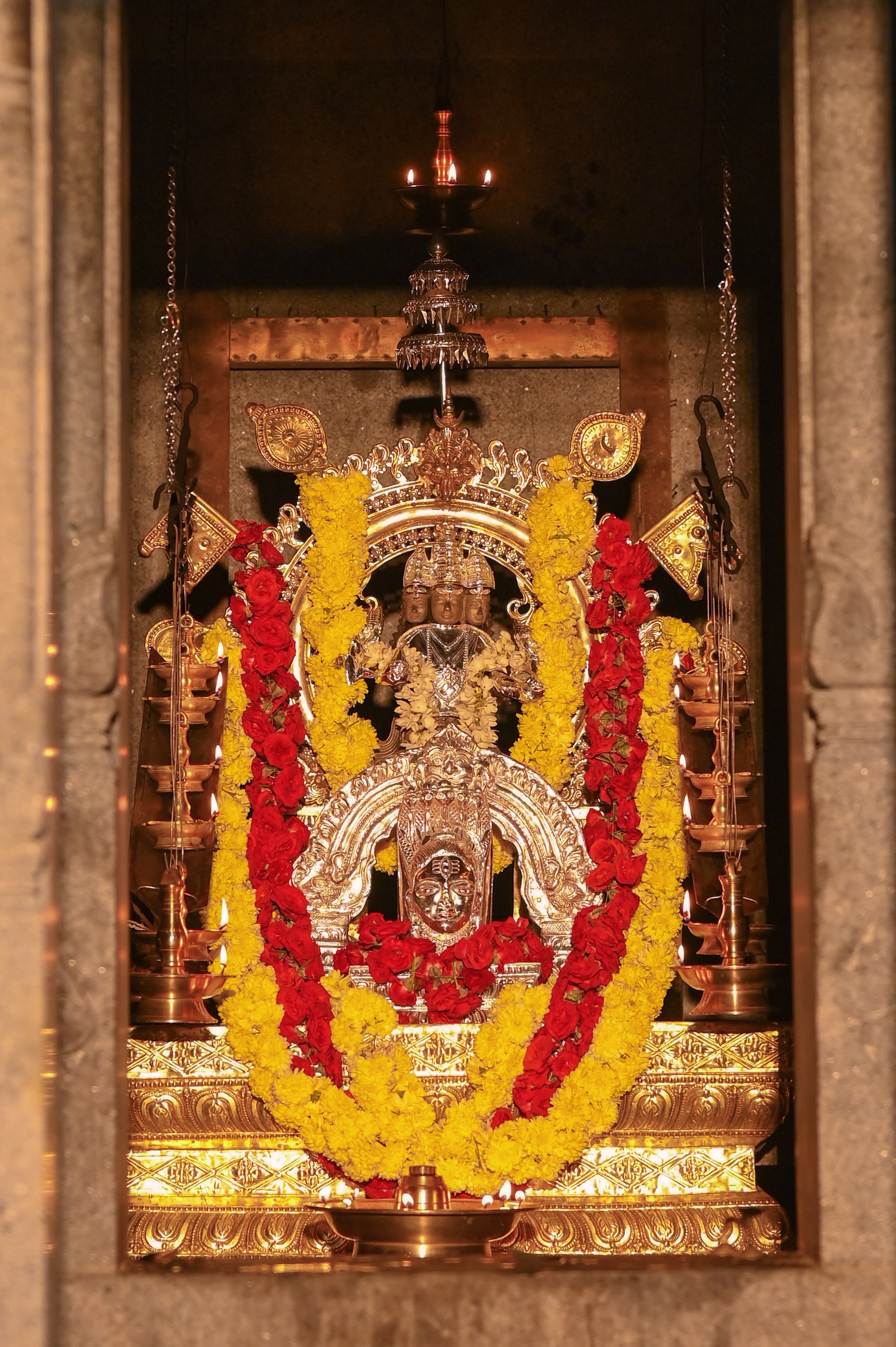
In the great land of Dakshina Kannada and Udupi district, where 'Nagas'(the snake god) is religiously worshipped there exist 1600 temples as per the Government records.From the various Daivas(Bhoothas) and Devas(Gods) that exist here, the story of Kananjar Shree Brahmalingeshwara has special importance and sanctity.Kananjar is also called as Kanajar.
If one is coming to the temple from Udupi,one should take the Udupi-Hiriadka-Karkala route.At Gudde Angadi(after Hiriadka) one must take the right turn towards Kananjar village.This temple is three kilometers away from here.One can also approach the temple from the Udupi-Palli-Bailur-Karkala road.Near kananjar church one must take the left turn. From here to the temple is just three kilometers.
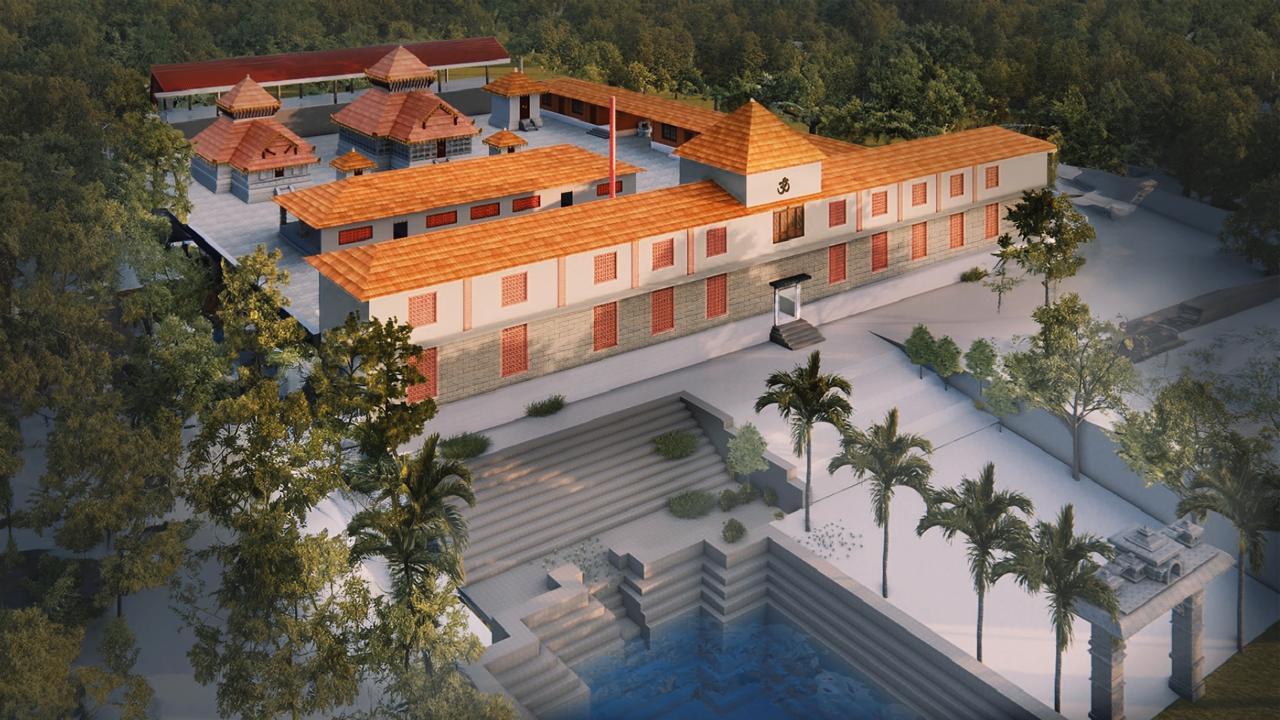
The route to the temple is absolutely mesmerizing with lush green forests and breathtaking mountains untouched yet by modern civilization.Situated in the midst of this scenic beauty stands the temple.Entering the temple one can't miss the beautiful architecture that takes you back to more than 850 years ago.
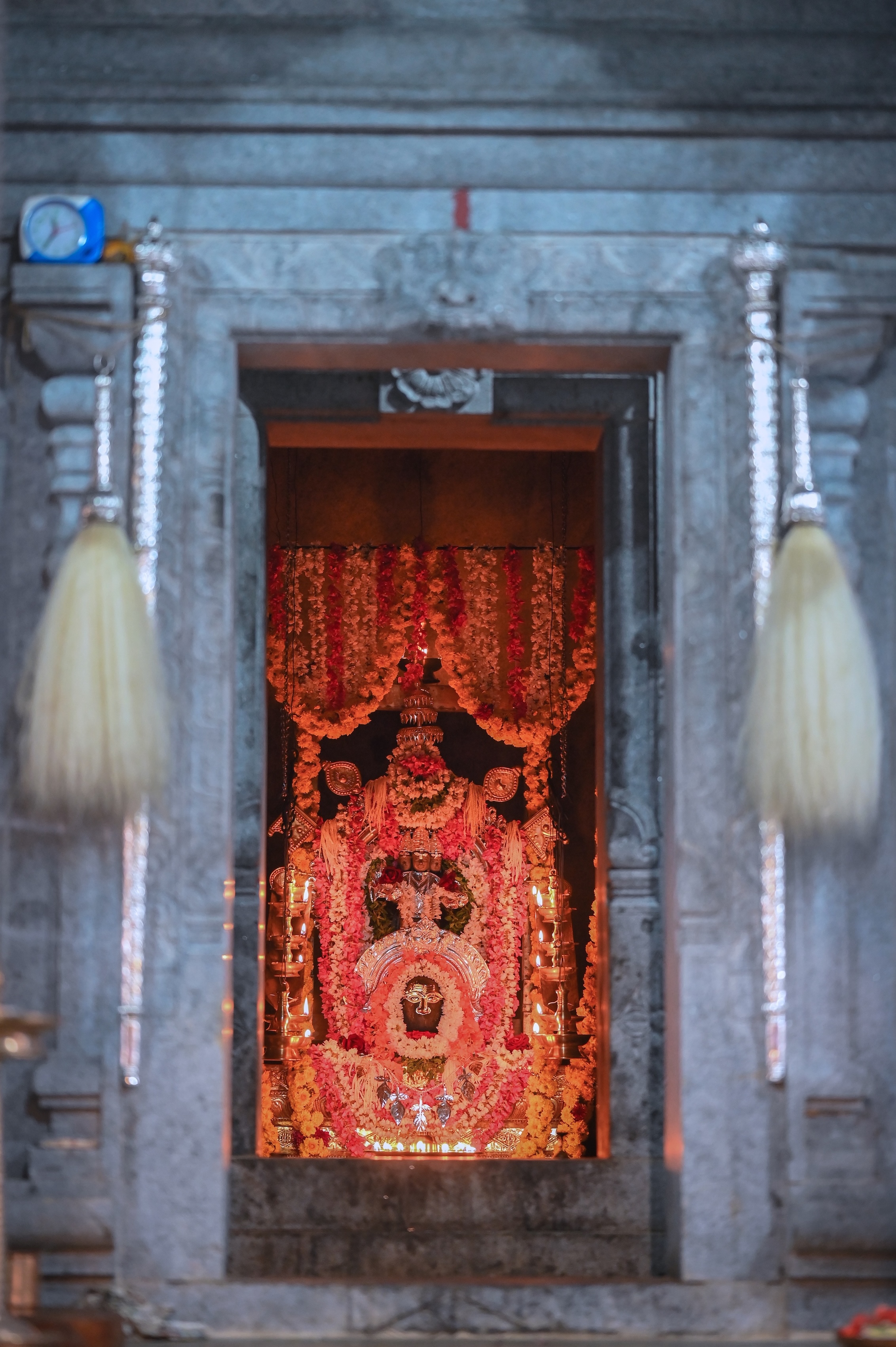
The temple has been constructed in accordance with the principles of Vaastu Shastra(the ancient science of architecture) and vinyasa (layout).The 'Garbhagudi' has been built based on the principles of chaturasra and 'Gajaya Aya'.As per the system that exists in most temples,every deity has a 'sthana' (an order of prominence).Similarity ,in this temple the pradhana devatha (main deity) is Shree Brahmalingeshwara, followed by Shree Veerabhadra, Shree Ganapathy , Shree Annapoorneshwari and then Shree Melbanta.
Sthala Purana
Every temple has a history attached to it and so does the Kananjar temple, which is claimed to have a connection with a story in the Shivapurananthargantha. Around a Hundred and Eight Kalpa ago there was a demon called Mayasura who lived on the mountain called Shesha parvatha. Along with his close aides Thrishika and Durmukha he created havoc in all the three worlds. By their misdeeds, they caused injustice and harm to the people. Mayasura meditated to Brahma and asked for a boon so that no one could kill him. Brahma was pleased with his meditation and granted him a conditional boon that Mayasura could only be killed by a person who was not born from the mothers womb.
One day Devendra from Devaloka along with all the other Devatas came to Sathyalok for Vanipati’s (Bharma’s) darshan. They then proceed to Vaikunta to meet Shripati from where they all come to Kailasha to meet Umapati. Lord Shiva was pleased to see all of them and welcomes them. It was obvious to the Supreme Gods that such a congregation of all the Devatas was either for a good karya or for dharma rakshane, which could be even at the cost of bloodshed. Knowing this Lord Shiva gives a Lingam made of Vaidoorya to Shrilola (Vishnu), Krishnashila Lingam to Brahma; Ratnalingam to Devendra and other kinds of Lingam to each of the Devatas and sends them off. The time for evil to be eradicated had come; therefore, Narada Muni goes to Mayasura and tells him that the Krishnashila Lingam which Brahma was given by Shiva would cause danger to him. This makes Mayasura furious and he takes his army and attempts to stop Brahma from proceeding to Sathyalok with the Lingam. Brahma fights Mayasura with his Dhanda and Kadga.
The war goes on for thousands of years. Brahma realizes that Mayasura could not be killed because of the boon given by him and therefore he remembers Lord Shiva. (The idol of Brahma at the Kananjar temple is that of Brahma going to war with Kadga and Danda in his hands.) Lord Shiva realizing that this was the right time to kill Mayasura goes to war with him. As Shiva was at war with Mayasura he created a Gana from his own body called Chandesha. Just from the eyes of Chandesha a strong brilliance kills thousands of Rakshasas, while his breath created a cyclone, which created havoc in entire Brahmanda. It was as if parlay kal was about to dawn. Chandesha bows to the Supreme beings Brahma and Shiva and asks them the reason of his birth. Shiva gives Chandesha a danda that had more power than the Vajhrayudha of Devendra and orders him to kill Mayasura.
Chandesha and Mayasura then have a very intense battle for a number of years. Just as ice melts due to the intensity of the sun similarly Mayasura also became weaker and weaker in the face of Chandesha. Mayasura fearing death picks up the Krishnashila lingam of Brahma and throws it to Bhooloka. This made chandesha furious and with his Danda kills both Trishika and Durmukha Mayasura realizing that his death too was nearing starts running away. Chandesha chases him and hits him with the danda. Mayasura falls to the ground. Chandesha rips open Mayasura’s stomach and removes his intestines and throws it. He plays with his blood bringing on death to the feared Mayasura. All the Devatas shower flowers on Chandesha and praise him for his success. Once again dharma is restored in Bhooloka and all the Rishi Munis were pleased. In this way many samavathswara(years) elapse. One day chandesha asks permission from Shiva to go to Bhooloka for tapasya. Shiva tells Chandesha that the Krishnashila lingam thrown by Mayasura has fallen at the place were Anantha and Padma Naga are with their Santhathi come together in that lingam. At such time Chandesha would also be present to serve both these supreme lords. This place will then be well known as Shri Brahm Lingeshwara Kshera in Bhoomandala. He then blesses Chandesha and sends him for tapasya.
After a number of years when Chandesha was doing tapasya at Kandya Kshetra. Sulekha and Kuvale who were the princess of Gandharva Loka come there. Seeing brilliance and good looks of Chandesha. Sulekha falls in lowe with Chandesha. She approaches Chandesha and tells him that she was taken up by him and proposes to him. Chandesh requests them to leave since he was a brahmachari and was doing tapasya. On being rejected by him she gets disappointed and curses him that he would be associated with meat eaters. Just as she curses him a miracle happens and the beautiful Sulekha is transformed into an ugly woman. Seeing herself, she and her sister are overcome with fear and grief. While coming to gandharva Loka they meet Narada Muni. On hearing their story, Narada asks them to go to Bhooloka and tells them to do seva of Chandesha. He tells them that when they get the darshan off all there together i.e. of Shiva, Brahma and Chandesha the curse would get wiped off and their original beauty would be restored.
They then pray to Shiva and are reborn as human beings in Bhoolok.
Sultan Bhadshah was a King of Vismitapur. Under his reign there was total adharma. There was no law and order and women and children lived in fear. People drew pleasure from the pain of others. One day Sultan Badshah goes to war with the King of Hoisala. Just as Sultan Badshah was about to flee as he was facing defeat, suddenly out of the blue an unknown warrior appears and with all his might defeats the entire army of Hoisala. The Sultan was dumbfounded and embraces the unknown warrior, as the victory was due to him. The Sultan appoints him as the Chief of the army. People addressed this warrior as Veerasenani and he came to be known as such .After Veerasenani took over as Chief he prevented the Sultan from doing wrong and slowly all adharma stopped. Though the Sultan was not in favour of this, he was scared of Veerasenani and therefore maintained silence. In the palace of the king was a dasi named Saara who from her attire resembled a Muslim. She however would rise early and after her bath would offer prayers to a Shivalingam every day. This surprised not only the Sultan but also the entire kingdom. Saara was a teenage beauty and the Sultan used to lust for her, but fearing Veerasenani he hesitate to do anything. One day the Sultan sends veera Senani with an invitation to another kingdom. Taking advantage of Veerasenani’s absence the Sultan asks Saara to come to his secret chamber. Sensing danger Saara feels that instead of living a disrespectful life it is better to commit suicide. She felt that if Veerasenani would have been there she would have been saved. “Shapavinasha Tapaniharana Kalaveekarana Vishmitaroopa” mentally praying this she proceeds to the Kings secret chamber.
Seeing Saara approaching his chamber the Sultan is pleased and over come with impatience he moves towards her to embraces her. Just then his head his chopped off his torso and falls to the ground. A furious Veerasenani is standing there with a dagger dripping with blood. Saara overcome with happiness bows at his feet. With the Sultan’s death dharma was restored. Having succeeded in his goal of restoring dharma Veerasenani proceeds to leave the kingdom. However the people stop him and ask him to take over as king. He refuses to do so and instead declares the son of the sultan as King asking him to rule as per dharma. He then leaves. Saara approaches him and requests him to take her along as she wished to do his seva. Both Veerasenani and Saara leave together. Since Saara’s attire befitted that of a muslim. People thought that they were both Muslims and on their way all Muslims provided them with food and water. They then reached Tulunadu.
At that time King Alupendra reigned Tulu Nadu at Varkoor (today Barkur). Ballal, the king of Parika Beedu who was a ruler under king Aluendra had a longstanding dispute with him regarding a girl. Veerasenani intervenes and resolves the dispute and he himself marries the girl. While passing Perampalli, the Christians of this place assume that the three some were Christians and offer them food and shelter. Thus these three were considered by some as Hindus, by some as Muslims and by some as Christains. Enroute their journey they established dharma and finally reached Kandya Kshetra. Here at Markhandeya Theertha after a bath when the threesome took darshana of Shiva Lingam, Veerasenani gets enlightened as to who he was, what he should do and where he sould proceed. They then move southwards.
With the blessings of Lord Shiva both Naga gods Anantha and Padma along with their santhati were living peacefully in the forests without any fear of garudas.Their abode was referred to as Bermere Katte. At this Bermere Katte along with Naga and Brahma were Lekkeshiree, Mahisandaya, Kshetrapala, Vyaghrachamundi and Panjurli. Since these Aadhi Moola Devas are staying at this katte, this katte came to be known as Bermere Katte. Veerasenani, his wife and saara reach Bermere Katte because of Shiva’s intentions. Envisaging the beautiful scene that had various kinds of trees, different kind of birds and animals many overflowing ponds and streams their hearts were filled with pleasure. At a place that was set slightly lower they saw a Shiva Lingam amidst an aura of light that was equal to more than a crore of light that any sun could shine. Besides the Lingam were two Nagas Anantha and Padma praying to the Lingam. This was the Krishnashila Lingam that shiva had given to Brahma and which was thrown by Mayasura. Saara was none other than Sulekha reborn while Chandesha was reborn as Veerasenani. On Seeing the Lingam and the hair-raising scene Veerasenani recalls Lord Shiva’s words. Veerasenani tells the Nagas that from henceforth the Lingam would be protected and guarded by him and in times to come Shiva and Brahma will come together here and this place would be known as Brahmalinga Kshetra which would be like Swarga, where justice would be meted as per truth and dharma. Till then he and his two companions would remain invisible. Hearing this the Nagas were very pleased and decided to leave the Lingam in his possession and went into the forest to do penance till the day Shiva and Brahma would appear. Veerasenani tells saara that because of their previous sins(karma) they have been born in Bhooloka, and that Kuvale too had also been born. Saara and Kuvale would have to be redeemed from their previous karma. At that time he would help them. Then all three of them became invisible.
In a Village called Bermerekatte which was under the rule of the Barkur king Veerapanday Deva, lived a king named Nayar Heggade. He was known for being dharmasheela (just and righteous), suguna sheela (Well charactered) and a great daivabhkata (great faith and belief in god). He was a firm believer in truth and ensured that no obstacles would be there in protecting truth. One day on hearing the troubles that wild boars and tigers were creating for the villagers he set out with his team for hunting. After a long tiresome day with no results they were all set to return when a huge wild boar came in front of them. This got the adrenalin out again in them. Chasing this boar Nayar got separated from his team and lost his way. Suddenly out of the maze of bushes and foliage a huge tiger leapt at him. Fatigued and lost in thoughts Nayar could not react to the tiger. He immediately realized that he was now dead man. At that moment there was a loud thud and the tiger fell dead vomiting blood. He saw an unknown person standing with a stick. Nayar asked his life saviour his identification. The man replied that he was nameless and was alone in this world. He said that Lord Shiva was his only consort. Hearing this Nayar was perplexed. Since this man had saved his life, Nayar offered him the post of the Chief of the armed staff. The stranger replied that he would not be able to perform the functions of the arm chief but would not mind serving the King as a mere servant in his palace. Nayar reluctantly agreed. The stranger then along with Nayar got him out of the jungle.
After the arrival of Melanta into the Doddamane, the entire Village prospered. The village was converted into a place where milk and honey flowed. Golden harvest bloomed even in arid lands. Slowly it dawned to Nayar Heggade and the villagers that Melanta was no mere mortal and had to be a messenger from God.
Listerning to Melanta’s preaching of the Vedas, the Upanishads, the prayers he recited to Lord Shiva and his preaching to life, Nayar’s one and only daughter Sundari got totally transformed and severed all ties from worldly attachments. She then dedicates her life to the seva of Lord Shiva. Nayar’s plans of getting his daughter married off to his nephew gets dashed to the ground with Sundari refusing anyone. Sundari then decides to go on a 40-day maun vrath (penance of silence) Nayar gets totally crestfallen with the events that have happened to his poor motherless daughter. Deep within Nayar felt that melanta was responsible for these events. He therefore asked Melanta to shift to the forest and ensure that the wild boars and tigers do not harass the villages.
In Kandyakshetra there existed a great Shiva Bhakt and Maha Tapaswani by the name of Adakathaya Muni. With his severe penance he appeased the Lord Shiva who grants him a boon of building 64 Daiva and Devalayas in the great land of Nagas(South Kanara). With this boon, he sets out with a rare statue of Brahma. The statue, a standing pose of Brahama had a veena in one hand; the second hand carried a kadga and dumroo, the third hand held a conch and fourth hand was outstretched. At Markande Teertha, as per Shiva’s desire he takes bath. As he leaves the place with the statue, 1001 Ganas and 1000 Bhootha Ganas follow him on the way, while passing through a thick forest in Bermere Katte it was sandyavandane (evening prayers) and time for his prayers. He therefore placed the statue on the ground near a pond. After having a bath and carrying Kepula flowers he came towards the statue. At that moment he experienced an amazing scene. In the place where he had placed the statue a round well-shaped cavity had been formed and in the midst of it his statue stood. In Front of the statue was a Shiva Lingam. Nagas with spreaded hoods were providing shade to both the deities. There was a lamp shining brightly in front. Slightly further there was a man standing and holding a Talegariya Thatra (a kind of umbrella made of Tale tree leaves). On either side were two women standing. All of them were reciting “ Aum Shree Brahmalingeshwara Vijayatho” “ Aum Shree Brahmalingeshwara Vijayatho” and praying. Adakathaya was so engrossed in watching this scene that he did not watch his steps. Accidentally he slipped and fell into the pit. At that moment he realized that what he witnessed was nothing but Shiva’s miracle. In total excitement and ecstasy he muttered the words “Na ninna kandu jari de, Na ninna kandu jari de: (Seeing you I slipped and fell down) and danced with thrill.
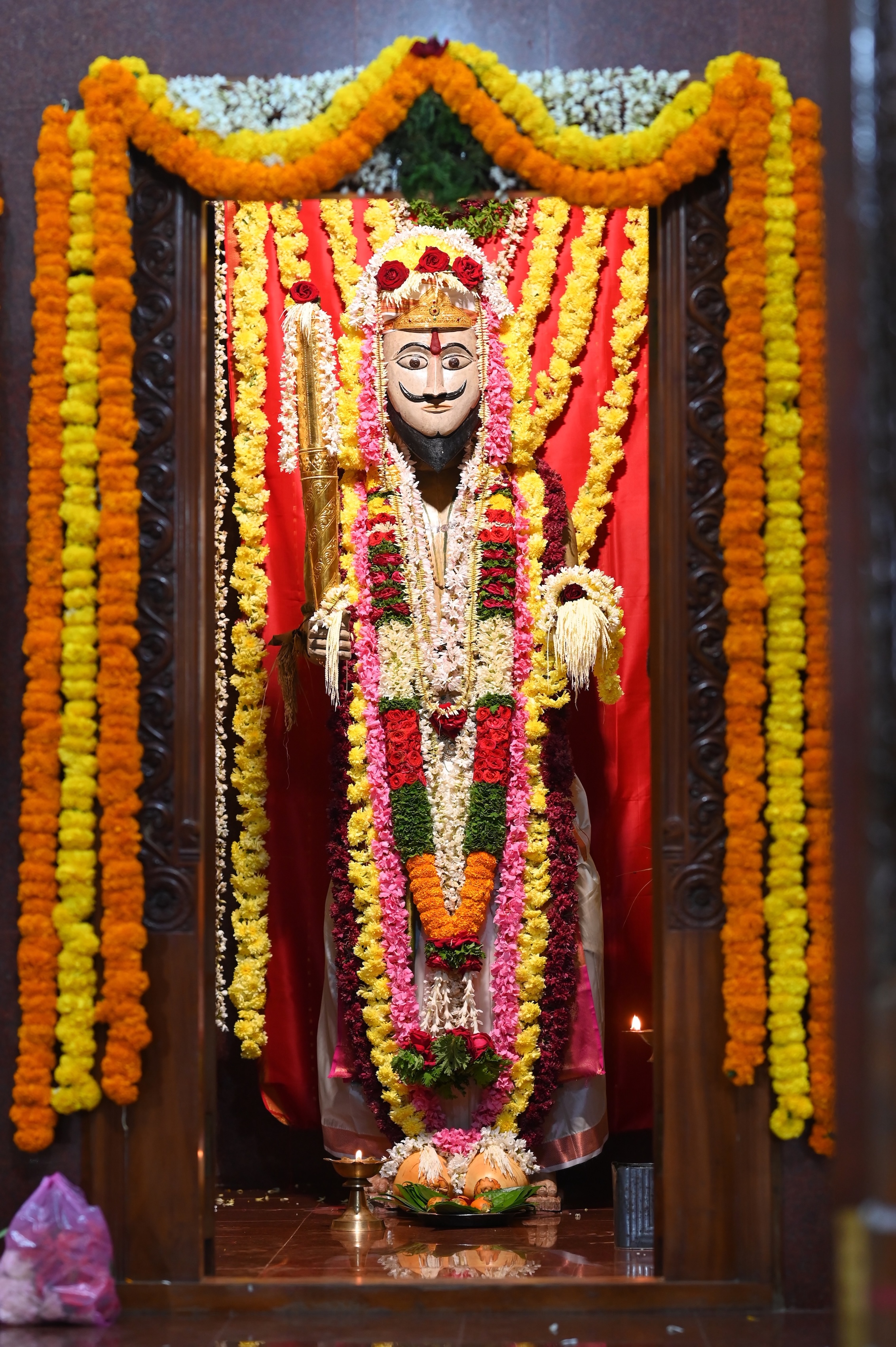
Adakathaya then went to the King Nayar Heggade and narrated the entire episode. Meanwhile, near the same venue a lady from the lower caste was chopping off the vine from the trees. Accidentally the sickle slipped from her hands and hit against the lingam. There was a metallic sound of metal hitting stone. When she peered to see what had happened she found that the sickle had hit the Shiva Lingam due to which blood was oozing from it. Frightened by this she started yelling for her son “Oh Kadanjo…, Oh Kadanjo..” and went running. Meanwhile hearing the episode from Adakathaya, Nayar was very surprised, but pleased with the incident. He immediately gathered his villagers and along with band vadyaa proceeded towards the site. On seeing the divine sight all offers their prayers to the deities. Adakathya then asks the person who was holding the umbrella along with the two ladies for his identification. The man replied that he was a sevak of the lord and that he was cursed to become a meat eater and that was why he was standing far away from the deities. He then asked Adakathaya to do his pratishtapana in front of these deities. At that time Adakathaya asked him to become the ‘Mel Banta’ (head warrior) of the 1001 ganas and 1000 bhoothas. He then blessed him and said that as ‘Kadanjara melbanta’ he would become well known. He then made the three of them disappear.
On realizing that the Melbanta was none other than his servant Melanta who used to do his work at home, was responsible for the change in his daughter’s attitude to life, was always in the front during any wars, Nayar broke into a cold sweat.
Because of the two events where Adakathaya after slipping had muttered the words ‘kandu jari’ and the lady from the lower caste yelling for her son ‘Kadanjo’ this village earlier known as Bremarekatte came to be known as ‘Kadanjaru’ “Today this village is also known as Kadanjaru, Kananjar, Kanajaru and Kanajar.
Since the place where the deities where there was not suitable for building a huge temple a site further south from this site and closer to the Naga bana was selected. The eastwardly facing temple was thus constructed.
Adakathaya placed in the Garbha Gudi’s paanipeetha the rare Brahma’s statue and the Shiva Lingam in front of it, and did its pratishtapana. On the right hands side the Veerabhadra Gudi and along with it Khadgeshwar’s pratishtapana was done. On the left hand side he did the pratishtapana of Vyaghrachamundi.
In front of the Veerabhadra’s Guddi, Katakshina Daiva Panjurli, Lekkeshree, and Dhumavati and on the Ishanya side the Kshetrapala and an Adakathaya Mantapa was built.In the field opposite to the temple a structure was built for Melbanta his wife and the woman he saved. The pratishtapana of these deities were also per formed. These deities face towards the temple.
On the right hand side Melbanta, he perfored the pratishtapana of the Ganas of shiva namely Karnikara, Bhringhi, Shringhi, Jaleshwara, Chandaka, Tarakesh, Somesha, Rudrakannike and other Ganas totaling to 1001 and 1000 bhoothas, for the protection of mankind.
This Kshetra then became famous as Shree Brahmalingeshwara Kshetra.
Nayar’s daughter who had done the 48 days fast came to the temple to do a special puja on the last day of this fast. She felt very elated and enlightened. Somehow she felt redeemed of all her previous sins. On her behalf there were special pujas conducted for the Devas, the Parivara Devatas and Ganas.
After the pujas, she fell at the feet of her father, brahmana, elders and villages. She then did a pradakshina thrice around the temple. She asked all of those gathered to follow her into the forest. When they reached the pond called nagateertha, near the south side of the temple, she narrated her previous life to those that had gathered. She announced that she was Kuvale, the daughter of a Gandharva. One day while traveling with her sister into Bhooloka, they saw the tapasaya Chandesha and committed an offence towards him. Due to which she had to be born as a human being in Bhooloka. After doing the 48 days penance and keeping a vratha of Brahmalingeshwara she was blessed with the combined darshan of Kanakavibhushana (Brahma), Nagabhushana (Shiva) and Chandesha (Melbanta) and therefore redeemed of her previous sins and had attained moksha. She then asked for blessings from all those gathered. Placing all her jewelry into the nagateertha, she announced that a day would come when Kananjar would be hit by misfortune. During these difficult days, in the Doddamane a one eyed bull, a barren buffalo together will be used to plough the fields. At that time to a mahapurusha these treasures would be gifted by divine grace. Suing this wealth he would help the village, till then she begged the Nagas to guard the treasure. She forewarned that those who would attempt to dig the treasure would do so at the cost of his life Saying this she disappeared.
Source- Kanajar Shree Brahmalingeshwara Kshethra written by “Kanajar Prabhakar Shetty”
Doddamane
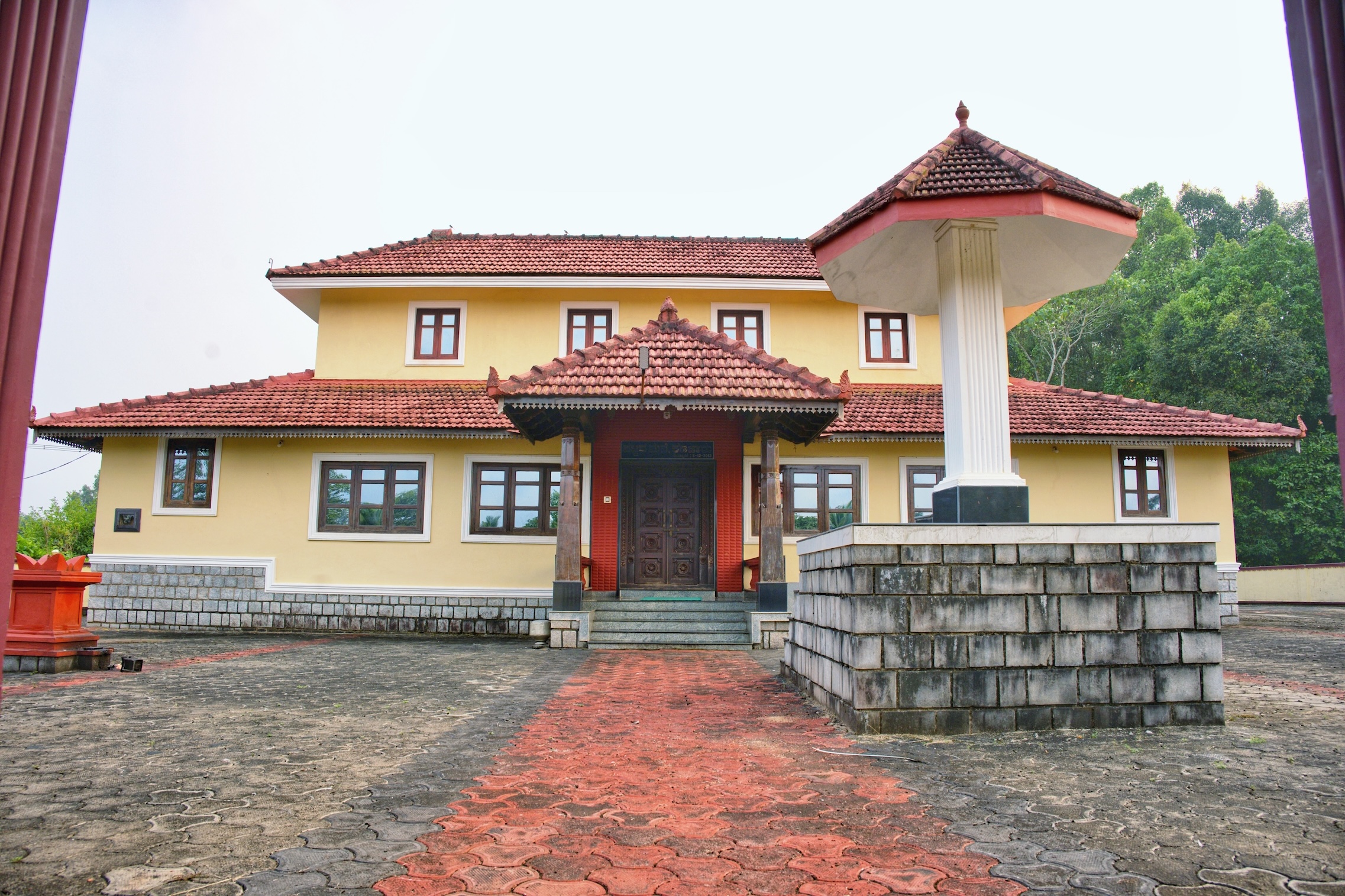
Kananjar Doddamane is having a history of 1000 years and it is estimated that the present house building was built around 300 years ago and housed the Arasu of Kanajar and was known for its Nyaya and Dharma. It had a demarcated portion called sathyada chavadi where disputes were settled. In the Chawadi are a Mari Mancha and the pattada mane (throne) where the arasu used to sit while deciding a case. The person seeking justice would stand in the satyada sthana where a sacred stone called Shakthi Kallu was there.One had to place their hand on this Kallu and swear to the truth.Today since Arasu does not exist ,during the utsav, Balimurthys deity is placed on the Kallu and a puja called Katte Puja is performed.
The huge pillars in the Chavadi are very impressive, made of one piece trunk and are called Bodhige Kamba. The doorframe in the chawadi bears carvings belonging to the Jain era indicates that the house was built by Jains.Today the house in a dilapidated state and portions of the house have collapsed.One can still see in the eastern and western fields the Samadhi of Nayar Heggade (doope) and others.Lighting of lamp (Sanadige Deepa) in the Chawadi is continued even today.
At one time 12 Maganes were under the rule of Kananjar Nayar Heggade. Kananjar was under the rule of Parika Aramanes Yernadu Ballala who in turn was reporting to the main arasu of tulunadu, Veerapandy, the ruler of Barkur. During the partitioning of his kingdom into 12 shares, he put 6 maganes of Kananjar under Neranki Heggade of Kattingeri and thus left Kanajar with only 6 maganes, and nominated Veera Nayar Heggade- II as the ruler of Kananjar.During this time the Heggade from Athradi,the Ala Heggade from Paddama, Kurla Heggade from Anjar, Kumara Heggade from Perdoor,Ainadu Heggade from Kabettu, Samantha from Mulky, Mardha Heggade from Kaup, Kinnari Heggade from Kanthavara were the rulers of their respective villages. The Baila Sooda from Karkala used to get Diwana Maryadi (a kind of respect in those days).
Under an agreement between Kananjar Veera Nayar Heggade and Krishnanand Vodeyar of Mysore, Kananjar was given freedom and a 13 step Pokare Kambala, a day light torch (Pagelda jitige), Nelapavadige (a white cloth that is spread before the kings feet when he walks), a white umbrella called the Shwethachatra that is held over head of only a chakravarthy.These articles are still can be seen today in Kananjar Doddamane.
It is estimated that Veera Nayar Heggade became the ruler during the year 1692 AD.
He ruled over Kananjar for 70 years till 1762 AD. Till his death he was a disciplined Brahmachari. Girls who had not reached puberty or woman who were in menopause were only allowed to serve him.He was also known for his bravery. He had dug under ground tunnels in places like Ayare, Mabunja, Derottu, and Jalalaguri to attack his enemies by surprise.He was known to have given sleepless nights to the brave and strong force of Tippu Sultan. He picked brave men from Vorasare and Ambodi.He managed to unite all the smaller kings to fight common enemies that would attack them.He was therefore respected and feared, and was the pride not only for his village but even in other areas too.
During the Temples annual utsav he used to be taken to the temple with the accompaniment of music, day light torch and Shwetha chatra like a Arasu.He used to return to Doddamane after completing the utsav activities at the temple. No other ruler in other villages had this privilege. His ability to call the 6 Maganes for a Vorasare to conduct mockwar and identify brave men was unique.
It is believed that there was a link between Nairs of Kerala and Nayar Heggades of Kanajar and the term Nayar is used in Kananjar Heggades name.In tulu language the plough that is used to till the paddy field is called “Naver” which is close to the name “Nayar” Therfore only in Kananjar, plough is called as “Guddal” as a mark of respect to Nayar Heggade. This followed even today. At one time Kananjar was a very rich village .There is evidence of many burried treasures in Kopparige which was washed away in floods. These places are called kopparige gundi today.After the defeat of Tipu Sultan the Britsh Government created a post of Patel called as “Patler” the designation given by the British government for the administration of the village and to collect the revenue from the villagers.
After the death of Veera Nayar Hegde, Mahalinga Hegde was appointed as Mukteshwar as well as first patel of Kanajar.After many years, a mjor discontent arose within this family for the position of “Patler”. At that time the family property went through a partition due to which the Mukteshwar of the temple and the the post of patel was separated from holding by a individual person.After the death of Mahalinga Hegde, his younger brother Manjayya Heggade -I, became the next Patel and Thimmaiah Hegde became the Mukteshwar of the Temple.
As per aliya santhana traditions after the death of Thimmaiah Heggade, Deranna Heggade became the next Mukteshwar.After Deranna Hegde, Angadimane Annayya Hegde became the next Mukteshwar followed by Parari Mane Manjayya Hegde and Doddamnae Shivram Hegde.After Shivaram Hegdes death a Managing committee was formed to manage the affairs of the temple. The trustees appointed Moodumane Damodar Hegde as Managing trustee in 1984. Sri Sudhir Hegde the present Managing Trustee has taken charge in the Year 2009. As the management of the temple was with the Doddamane family the family is also called as Bhandara Kutumba.
The post of Patel was also followed the aliya Santhana tradition. After the death of Manjayya Hegde-I, his nephew Achanna Hegde became the Patel. After Achanna Hegde, his brother Chandaya Hegde became the next Patel.After Chandaya Hegde, his nephews has not shown interest to become Patel as per aliya santhana tradition, there fore his son Shekhar Hegde became the next Patel till the the Indian Government abolished the post of Patel.
After Knowing the history of Kananjaru Doddamane one can come to the conclusion that the village was a prosperous village at one time. The 13 Pokare Kambala, Pagel Jeetige, Nelapavadige and Shwethe chatra are still used during annual utsav of the Temple.
After the death of Thimmappa Nayar Heggade in October 1879 the family propery was divided once again in to 4 shares among the family Members. Subsequently the property was further sub divided as Moodupalu and Padupalu and accordingly at present there are 12 houses of the family in Kanajar.
| Padupalu | Moodupalu |
|---|---|
| Doddamane | Doddamane/Moodubettu |
| Thenkumane | Kotrabakyar/Nadai |
| Parai Mane | Devasya |
| Hosamane | Kalkarumane |
| Berke Mane | |
| Dugganbailumane | |
| Moodumane | |
| Neere Bhadra Guthu/Hosamane |
The information is gathered from the senior members of the family and hence suggestions are solicited from other family members for corrections/additions if any in the details of family members furnished. Family members are also requested to furnish their present address and telephone numbers to Kanajar Doddamane Family Charitable Trust to update the record.
Melbanta Daiva
During the utsav a special puja is offered to Melbanta Deva.Devotteesoffer chicken as parake, to appease the Deva.The offerings amount to about 4000 chickens each year.
These are then taken to a field and de-feathered( the chickens are also tossed into bonfires to remove the small feathers).The muhurat for the cutting of the chickens is done by an 'achary' (wood cutter) by chopping a chicken with his vuli and hamer (wood cutting tools).All the chickens are cut into small pieces,washed and cooked in huge cauldrons (Kopparige).Simultaneously nine vegetarian dishes and rice are cooked.
A Moily(devadiga) archaka covering his mouth with a white cloth,places a banana leaf in front of Melbanta Dea, Mayandal and the Ganas and serves the food that is prepared.Puja is then performed and all those who have gathered pray to these deities. The food is distributed as prasadam.By the time the food is distributed it is nearly 4.00 am!.
This event is a classic example of community living where its success depends ont he cooperation of all castes and creed not only from this village but also from the surrounding villages.
To know more about Melbanta Daiva refer Sthala Purana
News & Events